The best way to manage your carbon footprint

Ensuring credibility 

WITHIN A COMPETITIVE

MARKET

Don't get left behind

Business transparency and climate action are increasingly important factors for customers, investors, and other stakeholders. Public disclosures of carbon emissions and credible strategies to achieve Net Zero are fundamental to maintain competitiveness and futureproof your business.

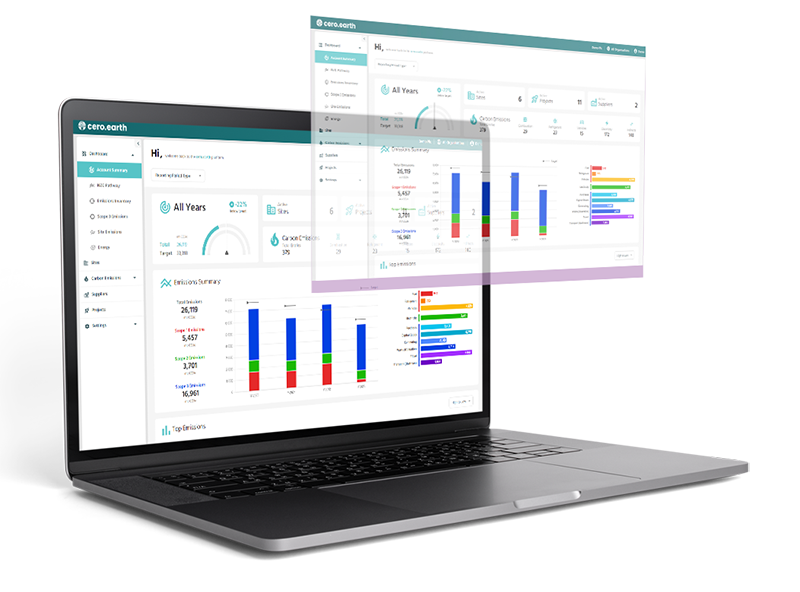
cero.earth helps you take control of your decarbonisation journey by calculating your position, ensuring compliance with regulation and clarity for your investors and stakeholders, and enabling you to plot your pathway to Net Zero.


Why should your business care?

Businesses are increasingly under pressure from customers, employees, shareholders, and the wider public to disclose their environmental impact and demonstrate tangible actions to reduce it.  Companies that fail to disclose their carbon emissions and have concrete decarbonisation plans are at risk of losing investor confidence and revenue from consumers, as well as incurring a negative brand reputation.

How does cero.earth help?

01 Increase transparency

cero.earth enables you to measure and track your scope 1, 2 & 3 emissions, ensuring you can easily disclose your emissions to your stakeholders and shareholders, instilling confidence in your transparency.

02 Manage projects

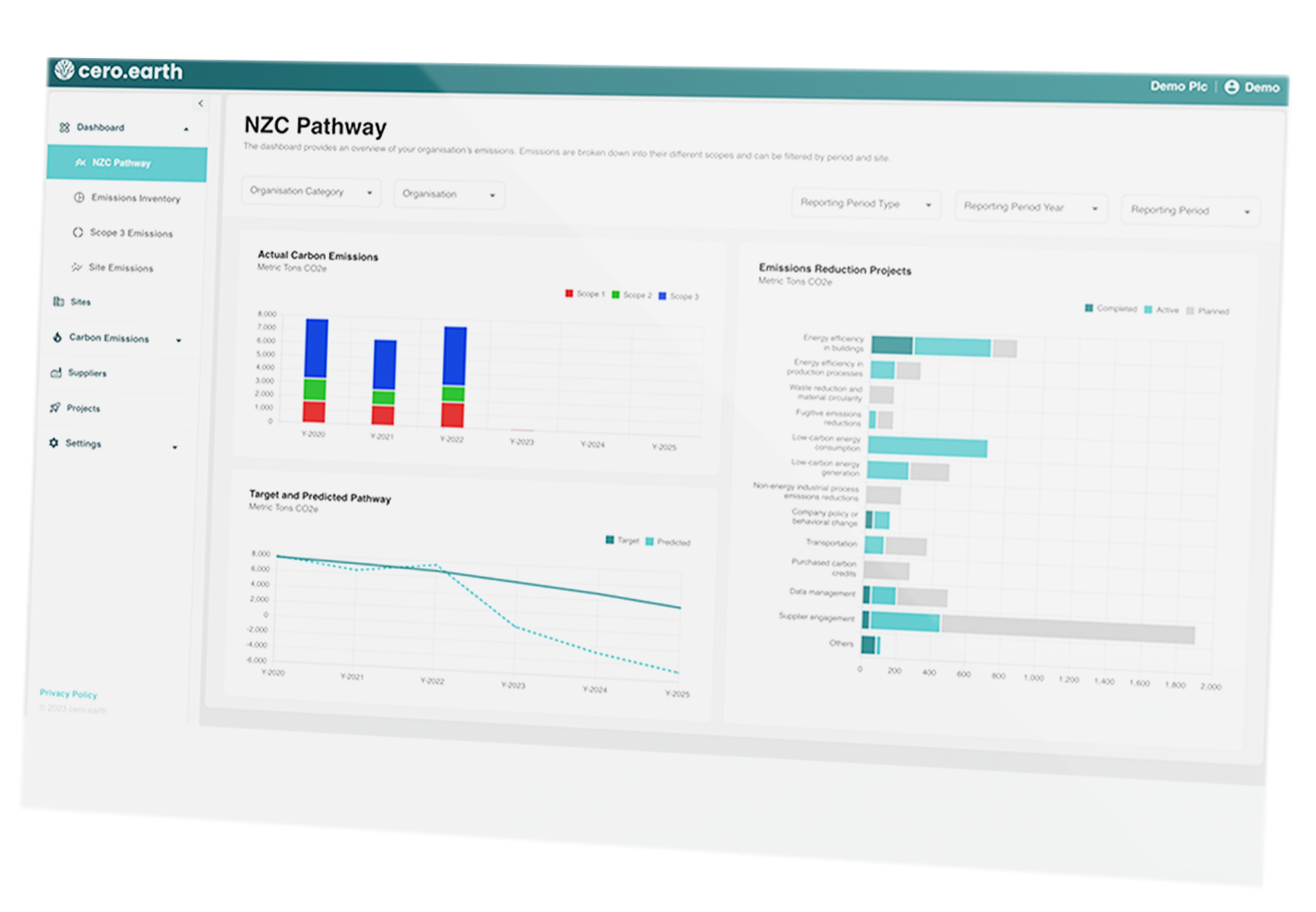
Demonstrate climate action to your stakeholders and shareholders. Plan, implement and monitor your emissions reductions, with cero.earth’s project tracking dashboard.


03 Data that matters

cero.earth allows you to easily export meaningful insights in a concise manner and answer requests from key stakeholders.


Data you can trust,

actions that deliver results

Our Climate Credibility Expert's

Advice & Guidance

by Doug Mccauley 23 March 2026
Why the transition to a lower carbon economy is fundamentally about operational resilience. For the past decade, sustainability has steadily moved up the corporate agenda. Boardrooms have become familiar with terms such as net zero, ESG reporting, and climate disclosures. Businesses have been asked to publish targets, measure emissions, and demonstrate progress against a growing range of frameworks. But somewhere along the way, the conversation became overly complicated. For many business leaders, sustainability began to feel less like a commercial strategy and more like a reporting exercise. ESG ratings, disclosure requirements, and long-term commitments increasingly dominated the discussion. In some organisations, this created frustration and fatigue. Leaders struggled to connect sustainability narratives with the practical realities of running a business. Yet the truth is far simpler than the debate suggests. Sustainability is not only about reputation or reporting. Financial returns and resilience are becoming priorities for businesses. Recent global events are reminding us of that reality. The Return of Energy Security For most companies, energy has returned to the centre of strategic decision-making. Recent geopolitical developments have once again exposed how fragile global energy systems can be. Escalating tensions in the Middle East and the resulting conflict involving the United States, Israel, and Iran have already triggered renewed volatility in oil markets. These developments are not isolated shocks; they are part of a broader shift in how global energy markets operate. For a long time now, energy commodity prices have not simply been influenced by supply and demand. They have been shaped by geopolitics, national security concerns, and global power dynamics. For business, this matters enormously. Energy volatility rarely remains confined to commodity markets. It quickly feeds into manufacturing costs, logistics, procurement decisions, and the price of goods and services. Supply chains tighten, inflation rises, and margins come under pressure. This is why energy security has rapidly returned to the board agenda. Leadership teams are now asking themselves the question: How exposed is our business to energy market shocks? Organisations that cannot answer that question clearly are increasingly recognising a deeper vulnerability within their operations. The Sustainability Narrative Lost Its Way At the same time that energy volatility has returned, the sustainability conversation itself has been undergoing a correction. Over the past few years, many businesses experienced what has often been described as ‘ESG fatigue’. Sustainability became associated with reporting frameworks, compliance obligations, and external scrutiny. The narrative grew increasingly complex, while the operational relevance sometimes became less clear. In some cases, sustainability programmes became disconnected from the core drivers of business performance. That disconnect has been exposed by the current global environment. When energy prices surge or supply chains become unstable, businesses quickly rediscover what sustainability was always meant to address: resource security and operational efficiency. The companies navigating this environment most successfully are not necessarily those with the most ambitious climate targets. They are the organisations that have invested in improving how their operations use energy, materials, and resources. They understand that sustainability is not an abstract environmental concept. It is a practical operational strategy. Businesses that use less energy, generate more of their own power, and reduce dependency on volatile commodity markets are fundamentally more resilient. They are also structurally more competitive. Sustainability Is Really About Risk and Competitiveness Seen through the right lens, sustainability is simply another form of risk management. Businesses today operate within a landscape of increasing regulatory scrutiny, rising energy costs, and growing expectations from investors and supply chains. At the same time, climate-related disruptions and geopolitical tensions are introducing new uncertainties into global markets. For many organisations, sustainability risks now intersect directly with core business risks. Energy price exposure can reshape operating margins. Supply chain disruptions can affect product availability and customer relationships. Investor expectations around climate risk can influence access to capital. Even insurance markets are beginning to factor climate resilience into underwriting decisions. Ignoring these realities does not remove the risk. It simply increases exposure. Yet the most interesting aspect of the sustainability transition is that the same actions that reduce risk often strengthen competitiveness. Businesses that improve energy efficiency lower their operating costs. Companies that electrify operations reduce dependency on volatile fossil fuel markets. Organisations that invest in on-site renewable energy gain greater control over their energy supply. In volatile markets, the businesses with the lowest and most stable energy costs will inevitably outperform those that remain exposed to global commodity shocks. This is why investors are increasingly shifting their focus. Rather than simply assessing climate commitments, they are looking at something far more fundamental: transition readiness and operational resilience. The Companies That Win Will Have Structurally Lower Costs The transition to a lower-carbon economy will not unfold evenly across industries. Some sectors will move faster than others, and the pace of policy change will continue to vary between regions. But one outcome is already becoming clear. The companies that succeed in this transition will have structurally lower energy, material and carbon costs than their competitors. They will operate with more efficient processes, smarter infrastructure, and more resilient supply chains. They will generate a greater share of their own energy and rely less on volatile global commodity markets. In other words, they will have fundamentally stronger business models. This is where the sustainability conversation needs to return. For too long, sustainability has been framed primarily as a reputational issue or a long-term climate commitment. While those elements remain important, they are not the primary reason why businesses are engaging with sustainability today. The real driver is economics. Energy, materials, and resources underpin every industry. Businesses that can secure them more efficiently and manage them more intelligently will always have a competitive advantage. In that sense, sustainability is not separate from business strategy. It is becoming the strategy. As global markets continue to evolve, leadership teams face a defining question. Will sustainability remain a reporting exercise within their organisation, driven by compliance and external expectations? Or will it become a strategic tool used to strengthen resilience, reduce costs and secure long-term competitiveness? The companies that answer that question early are already positioning themselves differently. In a volatile world, operational resilience may prove to be the most valuable asset a business can build. Supporting Organisations Through The Transition At edenseven, we work with organisations that want to approach sustainability as a strategic opportunity rather than simply a reporting requirement. Our focus is on helping leadership teams understand how sustainability connects directly to operational resilience, energy strategy and long-term cost competitiveness. This means looking beyond frameworks and targets to focus on the practical decisions that shape business performance: energy infrastructure, resource efficiency, supply chain resilience, and credible transition planning. The organisations that will lead the transition are not necessarily those making the loudest commitments. They are the ones building structurally stronger and more resilient operations. If you would like to explore how sustainability can strengthen your organisation’s operational resilience and competitive positioning, we would welcome the opportunity to start that conversation. Speak to a member of the edenseven team today!
The UK houses of parliament at night
by Doug Mccauley 14 February 2025
In 2023, the UK Government announced plans to introduce a carbon border tax from 2027, known as the UK Carbon Border Adjustment Mechanism (UK CBAM). This policy aims to prevent carbon leakage (the practice of shifting emissions-intensive production to countries with weaker climate policies) by ensuring that imported goods are subject to a comparable carbon price as those produced domestically under the UK Emissions Trading Scheme (UK ETS). Ultimately, the goal is to drive global reductions in industrial emissions and support the transition to a low-carbon economy. What is the UK CBAM? The UK CBAM will apply to imported goods in emissions-intensive industries. Starting in 2027, businesses importing iron, steel, aluminium, ceramics, cement, fertilisers, glass and hydrogen into the UK will be required to: Mandatory Disclosures: Submit reports detailing the carbon emissions embedded in their products (embodied carbon). The UK CBAM will require reporting to detail the Scope 1 (direct emissions from production), Scope 2 (indirect emissions from purchased electricity), and select precursor product emissions embodied in imported products. Levy Payments: Pay a levy based on the carbon pricing of the exporting country. If the exporting country has little to no carbon pricing, UK importers will be subject to a higher tax rate. This initiative encourages businesses to source materials from suppliers with strong carbon policies, incentivising sustainable production methods. How Will it Work? The UK CBAM will require importers to report and pay for the emissions embedded in their products at the UK ETS carbon price. If a foreign producer has already paid a carbon price in the country of manufacture, this may be deducted from the payment charge under UK CBAM to avoid double taxation. The UK Government has proposed to have four accounting periods per year to align with the standard practices used by other taxes. How Does the UK CBAM Differ from the EU CBAM? While both mechanisms share the same overarching objectives, there are key differences: Scope of Products : The EU CBAM applies to cement, iron, steel, aluminium, fertilisers, electricity and hydrogen, whereas the UK CBAM excludes electricity imports but also applies to additional products, such as ceramics and glass Implementation Timeline : The EU CBAM has already begun its transitional phase (October 1, 2023), requiring emissions reporting, with full financial enforcement starting in 2026. The UK CBAM, however, will take effect in 2027. What Can Businesses Do to Prepare? To limit exposure and ensure compliance with UK CBAM, businesses should take the following steps: Assess Supply Chains: Assess your exposure to UK CBAM by reviewing your suppliers to understand where imported products and materials are being manufactured and their carbon intensity. Identify other suppliers with lower-carbon intensities. Engage Key Suppliers: Work with your suppliers to encourage the adoption of low-carbon technologies and practices that will reduce the carbon intensity of manufactured materials. Consider switching suppliers and sourcing materials from UK-based companies that already comply with UK ETS, to reduce exposure. Comprehensive Emissions Reporting: Ensure you have sufficient emissions accounting and reporting practices in place, to minimise disruption caused by mandatory reporting. We recommend businesses understand their Scope 1, 2 & 3 emissions to identify high-impact activities and inefficiencies within their operations and their supply-chain. How We Can Help edenseven is a sustainability consultancy with a proven track record in designing and delivering data-driven sustainability strategies. Our cloud-based carbon accounting and management platform, cero.earth , simplifies compliance and reporting for businesses of all sizes. Why Choose cero.earth? Regulatory Compliance: Aligns with the Greenhouse Gas Protocol (Scope 1, 2 & 3) to ensure accurate and compliant carbon reporting. Expert Support: Backed by a team of analysts who guide you through the process, making compliance straightforward. Seamless Data Integration: Easily upload and export data in required formats with our integrated report building tools, for effortless reporting and disclosure. Enhanced Credibility: Track and disclose detailed emissions data to investors and stakeholders with confidence, ensuring enhanced credibility. Reduce Costs: cero.earth identifies high emissions sources and inefficiencies within your operations and supply chain, enabling you to make informed decisions about where to implement impactful change, saving you cost with CBAM and ongoing operations. Net Zero Project Tracking: Design, implement and track your carbon-reduction projects and leverage our Net Zero Carbon (NZC) dashboard to visualize your pathway to Net Zero and set strategic carbon reduction targets. Flexible Packages: cero.earth offers tailored packages to suit all businesses. For businesses seeking a hands-off experience, our Strategic package allows us to handle the entire carbon accounting and compliance process on your behalf, ensuring a seamless and fully managed approach, allowing you to focus on what you do best. Prepare Your Business for the Future With the UK CBAM on the horizon, businesses must take proactive steps to manage their carbon impact and ensure compliance. cero.earth by edenseven, provides the tools and expertise needed to navigate these changes with ease. Start your journey towards sustainable and compliant operations today. Get in touch today to learn more about how we can support your transition and comply with the latest sustainability regulations.
City skyline at night
by Doug Mccauley 20 June 2024
The Impact of Minimum Energy Efficiency Standards (MEES) on Commercial Properties As of 2023, commercial properties in England and Wales are required to meet a minimum EPC (Energy Performance Certificate) rating of 'E.' By 2027, this will rise to 'C,' and by 2030, it will further increase to a 'B.' Currently, around 80% of UK commercial properties fall below the 'B' rating, leaving landlords and businesses vulnerable to significant risks. Non-compliance could result in fines of up to £150,000 per non-compliant letting, as well as reputational damage that could affect your brand's standing. Why Retrofitting Is Crucial Approximately 80% of the buildings that will exist in the UK by 2050 have already been built. This means that in order to meet the country’s Net Zero target by 2050, the existing building stock needs to undergo rapid retrofitting. Effective retrofitting measures include improved insulation, efficient HVAC systems, heat pump installations, intelligent building management systems (BMS), energy-efficient LEDs, water and waste reduction strategies, and the integration of renewable energy solutions. Retrofitting not only boosts energy efficiency but also ensures compliance with rising environmental standards. The Rise of Green Leases Green leases are becoming increasingly prevalent in commercial property agreements. These leases often include sustainability clauses that outline both landlord and tenant responsibilities for reducing environmental impact. Common requirements may include sharing utility data, improving EPC ratings, adopting sustainable waste and water management practices, and using eco-friendly materials during retrofitting and repairs. Importantly, some green lease clauses are legally binding, and non-compliance could lead to the termination of tenancy agreements. Biodiversity Net Gain (BNG) Requirements From February 2024, the Environment Act 2021 mandates that new developments in England must demonstrate a 10% increase in biodiversity compared to the pre-development baseline. To meet these requirements, developers must follow DEFRA’s biodiversity metric for assessing biodiversity gains. This change further reinforces the need for sustainability in the built environment and emphasises the role businesses play in preserving ecosystems. Rising Demand and Increasing Rent Prices As demand for energy-efficient commercial properties rises, rental prices are likely to follow suit. Tenants may face higher rent costs, but the trade-off comes in the form of reduced utility bills due to better energy efficiency. This shift makes high-efficiency properties not only a more sustainable choice but also a financially sensible one in the long term. How edenseven Can Help At edenseven , we specialise in helping businesses navigate the complexities of sustainability with data-driven strategies. With a proven track record in delivering successful sustainability initiatives, our experts are equipped to support you across a wide range of areas—from biodiversity and nature-based solutions to electric vehicle fleet integration, power purchase agreements (PPAs), low-carbon technologies, building optimisation, and comprehensive business transformation.  Our team is ready to guide you through the steps required to enhance your sustainability efforts, ensuring that you take meaningful action to cut emissions, comply with regulations, ensure credibility with stakeholders, and reduce costs. Interested in learning more? Get in touch today and let’s discuss how we can support your sustainability journey.
Show More

REQUEST A DEMO

Contact Us