Britain's Electricity Generation - October 2025
Fuel Type Breakdown
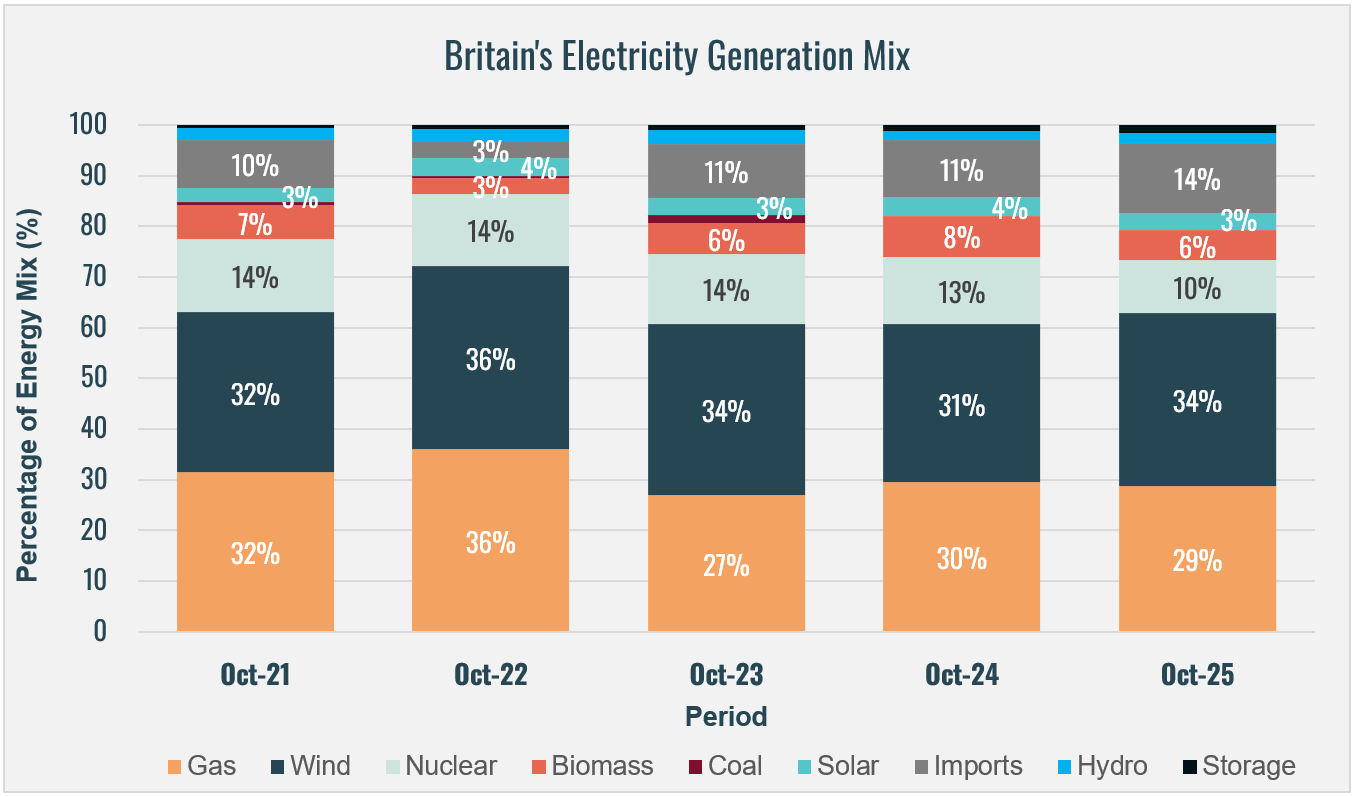
Britain's electricity generation in October 2025 was led by wind, which contributed 34% of the energy mix, matching its share from October 2023 but below the 36% recorded in October 2022. This represented a 3 percentage point increase compared to October 2024 and outpaced gas generation by 5 percentage points, reinforcing wind's position as a leading power source.
Gas, meanwhile, supplied 29% of electricity in October 2025, marking its second-lowest October contribution in the past five years. This decline highlights ongoing progress in reducing reliance on fossil fuels.
Electricity imports accounted for 14% of Britain's generation mix, up 3 percentage points compared to October 2024 and the highest October share in the past five years. This sustained level reflects continued dependence on cross-border electricity flows to balance domestic supply.
Nuclear power contributed 10% to the mix, down from 13% in October 2024 and below the 14% seen in 2021, 2022 & 2023. This marks a continued period of reduced nuclear availability.
Solar generation delivered 3% of Britain's electricity in October 2025, consistent with October 2023 and October 2021 but 1 percentage point lower than in October 2024 and October 2022.
Storage technologies supplied 2% of the mix, up 1 percentage point year-on-year and the highest October contribution in the past five years, signalling ongoing improvements in grid flexibility and battery capacity.
Biomass contributed 6% to the mix, 2 percentage points lower than in October 2024. Hydropower remained steady at 2%, largely consistent with October levels across the previous five years.
Coal remained absent from the generation mix, continuing Britain's phase-out of coal-fired power.
Zero-Carbon Sources & Carbon Intensity
Zero-carbon sources, including wind, solar, nuclear, and hydro, delivered 61% of Britain's electricity in October 2025, the highest October share of the previous five years and 10 percentage points higher than in October last year.
Carbon intensity for October 2025 remained static compared to October in the previous two years at 138 gCO₂/kWh. This stagnation suggests that more effort is needed to decarbonise Britain's electricity to ensure continued progress towards net zero.
Over the longer term, the 12-month rolling average for zero-carbon generation increased by 1% over the previous 12-month period, to 53%. In contrast, the rolling average carbon intensity rose by 8% to 133 gCO₂/kWh compared with the previous 12 months, signalling the importance of accelerating clean energy deployment to sustain downward momentum.
Concluding Remarks
October 2025 marked a relatively good month for Britain's renewable generation, with wind maintaining its position as the leading power source, though falling short of the 36% achieved in October 2022. Together with growing storage capacity, these sources helped sustain low carbon intensity levels.
However, the decline in nuclear generation and continued reliance on imports highlight the need for further investment in domestic clean energy infrastructure and flexible technologies. While progress in storage and renewable deployment is evident, maintaining long-term momentum will be essential to achieving sustained reductions in carbon intensity towards net zero and strengthening Britain's energy resilience.
Britain's Electricity Summary Charts
Monthly Statistics
12-Month Rolling (Average) Statistics
To explore more insights, visit our interactive renewables map
here.
Data source: National Grid ESO 2025
(https://www.nationalgrideso.com/electricity-explained/electricity-and-me/great-britains-monthly-electricity-stats)
About the Author
Doug is a specialist in carbon reporting and research, with extensive experience in supply chain emissions, regulatory compliance, renewable energy developments and sustainability performance improvement. He holds a Master’s degree in Green Economy, which underpins his ability to interpret complex environmental data and advise on practical, impactful strategies.
At edenseven, Doug leads the production of the firm’s monthly Britain’s Electricity Generation report, delivering clear, data-driven insights into the UK’s changing energy landscape. His work supports clients in understanding market trends, emissions performance, and opportunities for cleaner energy adoption.
Doug is a Registered Environmental Practitioner (REnvP) and an ISEP Practitioner, reflecting his professional standing and commitment to advancing sustainable practices across sectors.