
As global climate regulations come into effect, businesses are facing a growing demand to disclose
carbon emissions arising from their operations and their supply chain.
However, navigating carbon reporting standards such as TCFD, CSRD, and IFRS can be daunting for businesses. Their complex disclosure requirements combined with differing applicability criteria and staggered timelines puts
organisations at risk of reputational damage and fines for non-compliance.
cero.earth from edenseven is cloud-based carbon accounting and management platform. Designed to
support organisations of all sizes, cero.earth and expert analysts from edenseven will simplify reporting and
disclosure, ensuring your business is compliant with all relevant climate regulations.
The aim of climate regulations is to enhance transparency and understanding of climate-related aspects within an
organisation.
Disclosure typically includes:
- Governance: How the organisation’s governance addresses climate-related risks and opportunities.
- Strategy: The actual and potential impacts of climate-related risks and opportunities on the organisation’s businesses, strategy and financial planning where such information is material.
- Risk Management: How the organisation identifies, assesses, and manages climate-related risks.
- Metrics & Targets: The measures used to assess and manage relevant climate-related risks and opportunities where such information is material.
Understanding the regulations
The below table provides an overview of applicability criteria related to three of the main climate reporting
regulations, TCFD, CSRD and IFRS S1 & S2. The high-level disclosures required by the regulations in addition to
governance, strategy, risk management and metrics & targets reporting are also detailed.
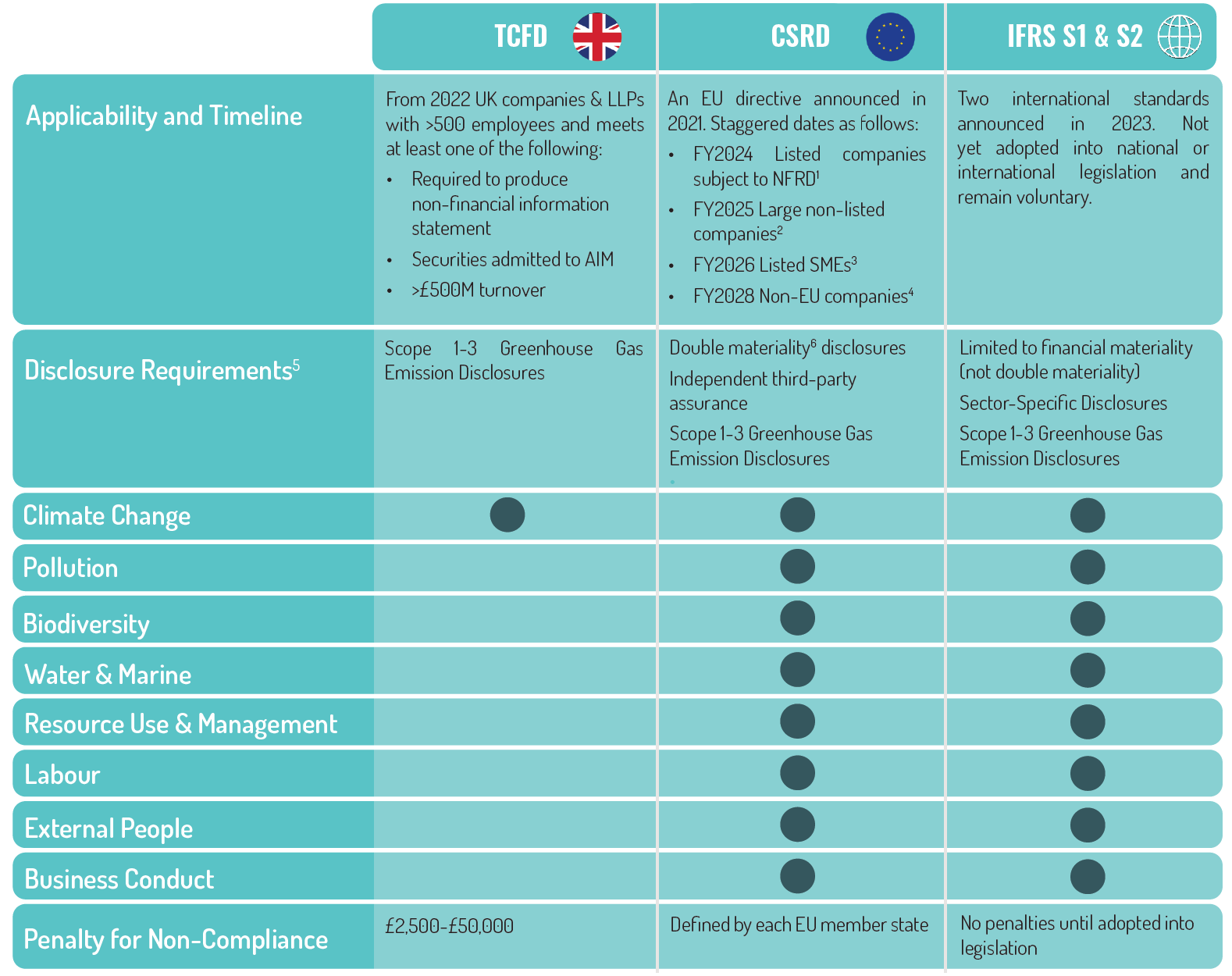
- Large EU public interest entities with 500 employees, report in 2025
- Large non-listed companies and meet 2 of 3 criteria: a. 250 employees, b. 40M turnover, c.20M assets, report in 2026
- Companies listed on EU regulated markets and meet 2 of 3 criteria: a. 10 employees, b.700K net turnover, c.350K assets, report in 2027
- Non-EU companies with 150M net turnover in the EU in the last 2 years and either a large or listed subsidiary or EU branch with 40M net turnover, report in 2029
- High-level examples of disclosure requirements, all disclosures subject to materiality
- Double Materiality: The company’s impact on people & planet and the impact of sustainability and climate on the company’s finances (required by CSRD)